EIFS vs. Traditional Stucco for Central Alberta Winters
Across Northwest Edmonton, the choice between EIFS and traditional stucco is not academic. Central Alberta winters decide how long exterior cladding lasts, how dry wall cavities stay, and how much a family pays to heat a home in Baranow, Hawks Ridge, Oxford, or Griesbach. For property owners comparing bids after searching , the right answer usually tracks the climate, the age of the building, and the performance target for the envelope.
Depend Exteriors works daily in Castle Downs, Big Lake, the Palisades, and Griesbach. The team sees what survives on 97 Street in a January wind and what fails on 137 Avenue after a rapid freeze-thaw swing. The practical difference between EIFS and cement plaster shows up in crack frequency, water management, energy use, and maintenance cycles. Those results inform the recommendations below for homes and commercial buildings from T5T and T5X to T5Y and T5W postal codes.
Why Central Alberta winters change the stucco choice
Edmonton’s envelope stress is extreme. Temperature can swing from -30°C in February to +30°C by July. That creates wall expansion and contraction. Traditional portland cement plaster, also called a three-coat stucco system, is a hard, brittle cladding. It includes a scratch coat, a brown coat, and a finish coat installed over wire lath. The second-layer cement plaster is durable but not flexible. Over years of movement, hairline cracks form. They widen with each freeze-thaw cycle. Water gets in, freezes, and forces more separation. Bulges and delamination follow.
EIFS, the Exterior Insulation and Finish System, behaves differently. It places continuous insulation (rigid EPS or XPS foam) outside the sheathing. A fibreglass reinforcement mesh is embedded in a flexible base coat. The acrylic finish coat has resin that can move with the building. It reduces cracking and blocks most liquid water while staying vapor permeable. This flexibility, plus a drainage plane behind the foam, is why EIFS dominates Alberta residential work since the early 2000s.
What EIFS offers in Edmonton conditions
Modern drainable EIFS is a multi-layer assembly that answers the two Alberta problems that damage exterior walls most: heat loss through studs and moisture trapped in cavities. A quality system in Northwest Edmonton includes a liquid-applied or sheet-applied water-resistive barrier over the sheathing, a drainage plane to let incidental moisture escape, EPS or XPS foam insulation boards adhered with vertical ribbons or mechanically fastened with washers, a base coat with fibreglass reinforcement mesh, a primer, and an acrylic finish coat with UV-stable pigments.
Continuous insulation blocks thermal bridging. That is the heat energy that shoots through studs and rim joists. In the 2026 Edmonton market, EIFS typically adds R-3 to R-5 per inch of insulation. A 2-inch EPS package can add roughly R-8 to R-10 to a wall section. Field studies and manufacturer data show EIFS can cut air infiltration up to 55 percent compared to brick or wood assemblies with no exterior air barrier upgrade. For a two-storey in Trumpeter or Starling, that drop matters when northwest winds funnel across Big Lake and Lois Hole Centennial Provincial Park.
Weight is another factor. EIFS weighs about 2 pounds per square foot, which is roughly 80 percent lighter than cement plaster. Less weight reduces stress on older framing in 1970s Castle Downs houses. It also makes architectural foam trims and window surrounds practical without heavy anchoring. Service life is comparable or better than cement plaster for residential use when installed correctly. Installers register the manufacturer-backed material warranty, typically 5 years for materials with finish life well beyond 20 years. With scheduled caulking maintenance at windows and control joints, a 25-plus year service life is common.
Where traditional three-coat stucco still makes sense
Cement plaster stucco remains useful for buildings where interior moisture control is minimal and impact resistance is a priority. Warehouses along Yellowhead Trail, storage buildings, and some farm outbuildings fall in this category. A well-detailed three-coat assembly with a proper water-resistive barrier and weep screed can last for decades. It resists dents better than EIFS. Costs in 2026 Edmonton range from $6 to $12 per square foot for standard assemblies on straightforward wall planes.
However, in residential use across Castle Downs, Palisades, Griesbach, and the inner-ring communities like Westmount and Kensington, the long-term crack pattern under expansion-contraction stress often offsets that impact advantage. Cement plaster gets harder over time. Flex is limited. Thermal movement keeps working the finish. That is why so many 1970s and 1980s Castle Downs stucco homes now show hairline cracking and localized bulges after 35 winters.
Acrylic finishes and cement board stucco in the Alberta mix
Acrylic stucco is a resin-based finish that can go over EIFS or over a cement base coat on wire lath. The acrylic layer has real flexibility compared to a cement-only finish. It also offers near-unlimited color selection and stable pigments. For homeowners who prefer a smooth or fine sand finish in Griesbach’s heritage-inspired streets, acrylic provides a crisp, modern look. In the 2026 Edmonton market, acrylic stucco installation generally ranges from $9 to $15 per square foot depending on substrate prep, details, and access.
Cement board stucco uses fibre-cement sheathing to create a stable base for a thin-coat system. It has uses on commercial storefronts and mixed-material facades where the design blends EIFS, thin brick, and manufactured stone veneer. It is less common for full-house re-clads but can solve project-specific detailing needs where rigid substrates and fast sequencing matter.
Neighborhood context that shapes the right choice
Northwest Edmonton is not one housing type. Castle Downs, framed by 153 Avenue to the north, Castle Downs Road to the west, 97 Street to the east, and 137 Avenue to the south, is mostly 1970s and 1980s single-family houses. Many have portland cement plaster stucco from original builds or 1990s upgrades. These are now in the replacement window. Hairline crack networks, chalking surfaces, and water staining at window heads are frequent. Owners comparing systems after searching tend to choose EIFS for flexibility, energy savings, and texture control.
Big Lake neighborhoods like Hawks Ridge, Starling, and Trumpeter represent current construction. Most new builds already use EIFS or acrylic finish systems that satisfy modern energy targets and builder warranty standards. In these pockets near Ray Gibbon Drive and Anthony Henday Drive, retrofit questions are fewer. The focus is on color changes, trim details, or stone veneer accents that suit wetlands vistas and new architectural guidelines.
The Palisades, including Oxford, straddles mid-1980s to early 2000s timelines. That means mixed exteriors. Some streets show original cement plaster. Others show early EIFS without drainage, which can have trapped moisture at window perimeters. Upgrades there often replace old barrier EIFS with drainable EIFS and new step flashing and sealant systems. Griesbach is a 620-acre former Canadian Forces base. Canada Lands Company led the redevelopment as a LEED ND pilot for a planned population of about 13,000. EIFS fits its energy efficiency goals and the architectural trims seen along 97 Street and 137 Avenue. The modern assemblies deliver consistent R-value bumps without changing the heritage-inspired look.
Freeze-thaw failure patterns seen on older stucco
Field inspections across T5X Castle Downs cul-de-sacs and T5L corridors highlight recurrent patterns. Hairline cracking starts at stress points such as window corners, control joints that were never cut, or long unbroken wall runs. Efflorescence appears where water is moving inside the wall and pushing salts to the surface. Delamination develops when water enters behind the cladding and then freezes, forcing the cement layer off the lath or sheathing. Bulges may align with missing step flashing at roof-to-wall transitions or with failed sealant at stucco-to-window interfaces.
These issues reflect the original assemblies. Cement plaster over wood sheathing without a modern drainage plane has nowhere to send incidental water. The Alberta freeze-thaw cycle then magnifies every small defect. On homes along Castle Downs Road and 97 Street corridors, the wind exposure accelerates surface wear. EIFS reduces these events by moving the dew point outward into the insulation layer, allowing the base coat and acrylic finish to move more freely and by draining water that sneaks in around penetrations.
Cost and scheduling in the 2026 Northwest Edmonton market
Budgets vary with access, elevation count, details, and substrate condition. For new EIFS or re-clads, straightforward projects in Northwest Edmonton typically range from $8 to $15 per square foot. Complex elevations with deep window surrounds, foam mouldings, or multiple finishes land between $12 and $20 per square foot. Traditional cement plaster sits around $6 to $12 per square foot. Acrylic finish coats across EIFS or over a cement base run about $9 to $15 per square foot. Those numbers reflect standard access; multi-storey scaffolding adds cost. Winter installations need heated enclosures and hoarding, which also increases costs.
Repair numbers inform replacement decisions. Hairline crack sealing on older stucco may run $6 to $15 per square foot of affected area. A 50-square-foot localized wall repair often totals around $800. Water-damaged substrate replacement runs $1,000 and up. Full moisture remediation with sheathing replacement and new water-resistive barriers can hit $5,000 or more in targeted zones. When owners in Oxford or Baturyn price everything, the math often favors an EIFS re-clad for long-term value if the house already shows wide cracking and early bulging.
Drainage, flashing, and joints that survive Edmonton winters
The best cladding system can still fail if the details are ignored. A drainable EIFS is only as dry as its water-resistive barrier and its pathways to daylight. A proper weep screed at the base of walls is mandatory to let water out. Step flashing and counter flashing at roof-wall connections keep meltwater from overloading one spot. Control joints and expansion joints break up long runs so the finish can move. Joint sealants with backer rod allow compression and extension without tearing the finish coat. Window perimeters need correct backer rod sizing and sealant chemistry that bonds to both the window frame and the finish system.
In Castle Downs driveways where snow loads pile against walls, clearances and terminations also matter. Cladding should not sit below grade. EIFS foam should stop above finished grade with a defined termination and a granular base that sheds water. These small design choices make the difference between a wall that looks new at year 15 and a wall that shows staining and cracks before year 10.
Energy and code signals that favor EIFS today
Alberta’s energy requirements direct builders toward continuous insulation strategies on Part 9 houses and small buildings. EIFS provides that CI in a clean assembly with proven cold-climate roots dating to postwar Germany. That is why EIFS took market share in Alberta between 2000 and 2004 and has held it ever since for residential exteriors. In Northwest Edmonton, where north and west elevations take the brunt of wind and cold, EIFS helps stabilize interior temperatures. It lowers furnace cycles in T5Y subdivisions near Anthony Henday Drive and cuts drafts in older T5W streets with original framing that leaks air around corners and sills.
For custom homes near Big Lake or infill builds along 127 Street and 137 Avenue, an EIFS package that adds R-8 to R-10 to the exterior wall can be the difference between hitting an energy target comfortably or having to upsize equipment. The acoustic benefit is a bonus. Continuous exterior insulation quiets traffic noise from 97 Street and Yellowhead Trail better than a bare sheathing and siding combination.
Textures and color that fit Northwest Edmonton streets
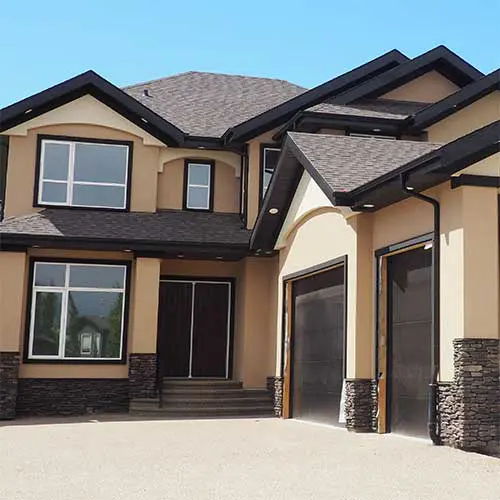
Finish selection should read as intentional with the neighborhood. Sand finish, also called float finish, works across most elevations and hides minor substrate wave. Lace or skip-trowel finish masks imperfections on older walls. Smooth finishes suit Griesbach townhomes and contemporary infill on Westmount side streets but require careful substrate prep. Acrylic topcoats provide even color in warm cream, soft ivory, sandy taupe, charcoal, and modern black with light trim accents that have been popular in 2026. Foam mouldings create cornices, window surrounds, and trims that echo the castle-themed street names in Castle Downs without the weight of old cement trims.
A shareable local insight about timing and demand
Castle Downs was carved out under a 1971 outline plan and expanded in 1983 with a Scottish-castle naming theme. That planning history created a tight construction window. Many homes received cement plaster stucco within a 10 to 15 year band. Those walls are aging out together across Baranow, Baturyn, Beaumaris, Caernarvon, Canossa, Carlisle, Chambery, Dunluce, Elsinore, Lorelei, and Rapperswill. This synchronized end-of-life pattern is why there is a visible wave of stucco replacement work in the 2020s in that footprint. The same history explains why drainable EIFS retrofits cluster now along 153 Avenue and Castle Downs Road.
Residential versus commercial choices
On houses and small multi-family, EIFS with acrylic finish checks the boxes for energy, flexibility, detailing, and finish quality. It delivers value in T5X Castle Downs cul-de-sacs and in T5T Big Lake enclaves. On commercial shells along Yellowhead Trail or in warehouse districts, hard-coat cement plaster or hybrid systems can still be sensible, especially where forklifts and carts will bump surfaces. Where a commercial owner wants the energy benefit of EIFS but needs extra impact resistance, heavier mesh weights and high-impact base coats upgrade the lower wall zones.
Parging, foundations, and dry bases for long-lived cladding
Cladding system choice is only part of a durable exterior. Foundation parging protects exposed concrete at grade from splash-back and freeze-thaw. Northwest Edmonton sees crumbling parging where spring runoff hits unprotected concrete day after day. Fresh parging runs about $5 to $10 per square foot in 2026. It pairs well with re-clad projects so elevations finish cleanly from top to bottom. Homeowners often ask about how to repair a cracked foundation during exterior work. That question points to structure-first priorities. True foundation structural repairs belong with foundation specialists. The exterior cladding team coordinates parging and wall terminations so water does not drive recurring damage.
What a durable EIFS or traditional stucco scope includes
Northwest Edmonton projects that last share consistent elements. The crew installs a water-resistive barrier and verifies window flashing at sill pans and jamb legs. They integrate a drainage plane on EIFS so incidental water can exit at weep screeds. They tie step flashing into roofing at every wall intersection. They design expansion and control joints to match wall geometry. They embed fibreglass reinforcement mesh fully in the EIFS base coat with correct overlaps. They prime and finish with an acrylic coat that suits Alberta UV exposure. They finish perimeters with sealant and backer rod sized to joint width. And they register manufacturer warranties where required by Dryvit, Sto, Senergy, Parex, Adex Systems, or Durabond.
Texture matching and transitions on mixed-material facades
Older homes in Athlone, Dovercourt, or Prince Charles often combine stucco with cultured stone or thin brick. Transitions need clear drip edges and back-wrapped mesh so stucco does not wick water from masonry. Where repairs touch small areas, matching sand size and pigment is the difference between an invisible patch and a spotlighted scar. Expect a texture matching premium of roughly $2 to $6 per square foot in targeted zones. Property managers along 127 Street and 137 Avenue have learned that small test panels pay for themselves by preventing whole-wall repaints after a poor match.
Why EIFS became the Alberta default between 2000 and 2004
By the early 2000s, builders had lived through over a decade of residential crack complaints on cement plaster. Alberta homeowners wanted better energy performance as natural gas prices fluctuated. EIFS solved both. It blocked thermal bridges and cut air leaks while flexing with seasonal wall movement. Early barrier EIFS in other concrete foundation repair estimate regions had moisture issues in the 1990s. Drainable EIFS addressed that with a defined air and water control layer and a drainage path. Since then, EIFS has been the dominant choice for new residential cladding across Central Alberta because it fits the freeze-thaw reality better than every rigid alternative.
Access, logistics, and Northwest routing matter to cost
Project access in Northwest Edmonton varies with the street grid. Houses near Anthony Henday Drive and Ray Gibbon Drive mobilize quickly from 176 Street NW, which keeps crew time tight. Tight back lanes in Westmount and Woodcroft need smaller equipment. Multi-storey condo work near Northgate Centre and along 97 Street needs swing stages or frame scaffolding and traffic control plans. Weather windows matter. Edmonton winter extremes stall wet trades when temperatures drop and humid air masses move in. Crews plan around dry days for water-resistive barrier installation and finish coats and enclose winter work zones to maintain curing conditions.
How owners use the choice to solve real problems
Castle Downs owners seeing spider cracks at window heads often replace with EIFS to end the cycle. Baturyn residents who notice water staining at parging lines use a re-clad with correct weep screeds to stop the problem for good. Oxford homeowners who inherited early barrier EIFS from the late 1990s upgrade to drainable EIFS to resolve hidden moisture around windows. Griesbach custom home clients choose acrylic finishes to hold color under strong summer sun and to achieve the smooth finishes that match streetscape guidelines. For Big Lake new builds, EIFS packages get sized early to align with energy modeling, then paired with cultured stone at the base to manage snowbanks and shovels.
Answers to common project trade-offs
Impact versus flexibility: cement plaster wins for point impact, EIFS wins for seasonal movement. Energy: EIFS wins outright. Initial cost: three-coat cement plaster can be the lowest, but lifetime maintenance favors EIFS in Alberta. Finish control: acrylic topcoats deliver the most predictable color and texture on both systems. Warranty structure: EIFS combines manufacturer material warranties with contractor workmanship coverage; cement plaster relies more on workmanship and paint schedules for color retention.
Northwest Edmonton case signals property managers watch
Along 153 Avenue near Griesbach Lake, low-rise condo boards often plan EIFS retrofits in phases. They start with windward elevations and window-heavy facades where energy and infiltration gains are immediate. On 137 Avenue retail pads, owners use cement plaster or hybrid high-impact EIFS at the first 6 feet and standard EIFS above to balance cart impact with thermal performance. In Rapperswill and Chambery, new infills leverage EIFS to reduce furnace sizing while meeting architectural guidelines that call for traditional trims. These patterns repeat because the weather is the same year after year and the envelope physics are consistent across T5X and T5E postal codes.
Why details decide finish longevity
Weep screed lines must sit level and consistent to maintain even drainage. Foam thickness must accommodate reveals and trims without starving the base coat at edges. Mesh weights can be increased at corners and doorways for resilience. Drip edges over stone wainscoting prevent dirty water stripes. Sealant schedules matter. In Edmonton’s UV and ozone exposure, exterior sealants last 5 to 10 years. Replacing them on time keeps water from finding blind routes behind beautiful finishes.
What owners in T5T, T5X, T5Y, and T5W should take from the comparison
For residential exteriors in Central Alberta winters, drainable EIFS with an acrylic finish coat is the proven default. It resists cracking as walls move, delivers real energy gains, and manages incidental water with a planned path out of the wall. Traditional cement plaster has a place on impact-prone commercial shells and farm structures but loses longevity on homes that face decades of freeze-thaw. Acrylic finishes bring color and texture control to either path. In Northwest Edmonton, the neighborhood age and the expected use case decide the rest.
Local availability and end-to-end service capacity
Depend Exteriors operates from 8615 176 Street NW in the T5T postal zone with direct access to Anthony Henday Drive and Yellowhead Trail for fast deployment to Castle Downs, Big Lake, the Palisades, Griesbach, and the older standalone neighborhoods including Westmount, Calder, and Kensington. The team installs EIFS, acrylic stucco, traditional cement plaster, cement board stucco, parging, exterior caulking, and stone veneer. The crew integrates water-resistive barrier installation, drainage plane detailing, window and roof step flashing, weep screeds, and expansion joints to suit Edmonton winters. That integrated approach means one contractor owns the envelope details rather than splitting work across trades that do not coordinate joints, sealants, and drainage.
For readers currently comparing bids after searching
Owners who typed are usually planning a new EIFS installation, a full exterior re-clad, or a hybrid façade with acrylic finish, cultured stone, and trims. The decision is time-sensitive if active cracking and water staining are present. For houses along 97 Street and 153 Avenue, waiting another winter can turn a re-clad into a substrate replacement in localized zones. When the system choice swings budget and schedule, a site walk is the quickest way to align scope with climate reality.
Depend Exteriors is a family-owned and family-operated Alberta Licensed and Alberta Bonded Contractor with 13-plus years operating in Edmonton and 15 years of exterior finishing experience. Owner Hasan Yilmaz leads the team. The company carries liability insurance that protects client property and project investments. Manufacturer-backed material warranties on EIFS systems are registered when specified, and workmanship warranties apply to installation labor. The extended six-day operational schedule runs Monday through Friday 8 AM to 7 PM, Saturday and Sunday 8 AM to 3 PM to match Northwest Edmonton project windows. Service coverage spans Castle Downs, Big Lake, the Palisades, Griesbach, Westmount, Calder, Lauderdale, Rosslyn, Athlone, Dovercourt, Sherbrooke Wellington, Woodcroft, and the full Edmonton metro including St. Albert, Sherwood Park, Spruce Grove, and Parkland County.
Property owners ready to move beyond research on can request a free estimate and a transparent written quote. An estimator will review the wall assembly, discuss EIFS, acrylic, or cement plaster options, note drainage, flashing, and control joint requirements, and provide a clear scope with 2026 per-square-foot pricing and schedule. That meeting sets the project on a path that matches Central Alberta winters and solves the real problems the building faces.